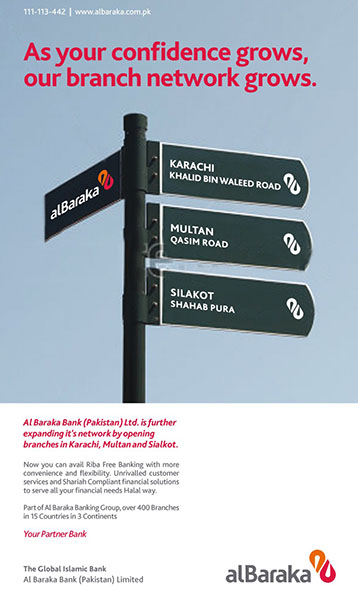
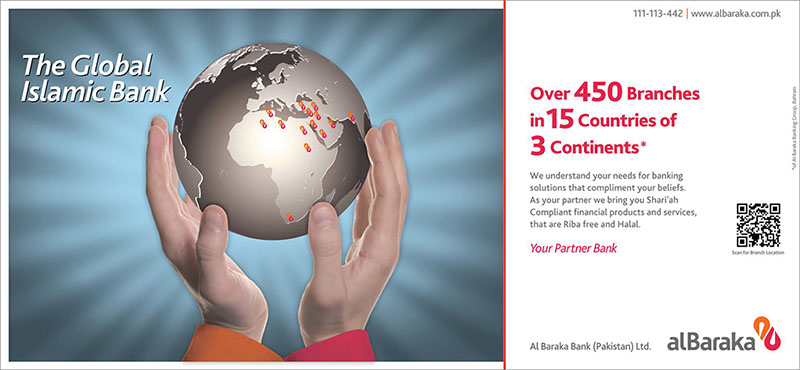
Al Baraka Bahrain operates in Bahrain, where it was one of the first Islamic banks to be established, under a retail banking licence, and in Pakistan, where it commenced operations in 1991 as a foreign bank established under a commercial banking licence from the State Bank of Pakistan. As part of its growth strategy, in October 2010 the bank completed the acquisition of Emirates Global Islamic Bank (EGIB), merging the Pakistan branch networks to create one of the largest Islamic banks in Pakistan, the resultant new entity emerging as a subsidiary of Al Baraka Bahrain: Al Baraka Bank (Pakistan) Limited.
The Bahraini economy maintained the steady growth pattern seen over recent years, as the rate of GDP expansion rose from 2009's 3.0% to an estimated 4.0% in 2010. Per capita GDP now stands at some $27,500, up from an estimated $25,000 in 2009. At the same time, efforts to contain inflationary trends proved quite successful, with the rate of inflation recorded over the year falling to around 2.6% compared with 2.8% in 2009. The current account surplus rose from 2.7% of GDP to an estimated 5.2% of GDP. Efforts continue to reduce the extent of dependency on the oil and gas sector and to reduce the country's unemployment rate by encouraging greater direct investment. In light of recent events in the MENA region, the government is seeking greater stability and security for the country, given the huge strides that have been made in the Kingdom over the last decade and more to encourage overseas investment, in particular in the area of banking which enjoys the grounding of legal and regulatory infrastructure which has been put in place and which is second to none in the region.
The impact of the devastating floods that hit Pakistan in 2010 not only resulted in huge human suffering at the time, but continues today to affect everyday life: frequent power outages and a deteriorating security situation being among the consequences. Some 310,000 businesses are estimated to have suffered, quite apart from the agricultural sector – accountable for some 20% of the national economy – and especially the cotton fields, which have suffered some 14 million bales lost through damage. Sugar, chipboard, paper, leather, rice, livestock, power plants were also deeply affected. At the same time, in accordance with Pakistan's agreement with the IMF, the removal of fuel subsidies and, accordingly, the upward adjustment of electricity tariffs, continue to bring rising energy costs, which naturally have a knock-on effect on those industries that are heavy energy users – textiles and cement for example. Higher commodity prices are unavoidable in the short term. Continuing worries over inflation – 13.6% in 2009 and currently projected to be around 13.9% yearon- year - have compelled the State Bank of Pakistan to raise its policy rate (which directly affects the inter-bank rate) to 13.5%. Consequently, current economic growth is estimated to have fallen to 4.8%.
Following a comprehensive internal review, Al Baraka Bahrain is in the process of adopting a new Strategic Plan, the implementation of which has occupied and will continue to occupy much of its attention. The acquisition of EGIB and merger of its Pakistan branches represented an important part of its plan to go for growth, in addition to demonstrating its ongoing commitment to the Pakistan market. For the Bahrain operations, its growth strategy has involved the introduction of new products to broaden the product portfolio and thereby increase its customer base. The success of this exercise can be judged by the 18% increase in the number of financings and investments accounts; likewise, the number of deposit accounts expanded by over 6%. Building on the success of its Taqseet (instalment) product introduced last year, the bank launched a new product in November 2010 - the Taqseet Card, believed to be unique in the market; this product offers multiple Murabaha finance transactions through a single card, which has so far evinced solid interest from the retail market. Residential mortgage finance, launched in 2009, remained in demand. The bank has also introduced several new financing products related to car financing and goods financing. On the commercial side, letter of credit issuance increased by over 50% above that of 2009. Revenues from banking services meanwhile almost doubled due to the increase in the bank's foreign trade business and increased income from packaging and booking transactions.
As a consequence of this increased activity, Al Baraka Bahrain's total Bahrain-based assets increased by 10% over 2009 to reach $690 million, as total financings and investments grew by 28% to $608 million. Deposits and unrestricted investment accounts grew by 12% to $522 million, mostly on account of a 22% rise in URIAs. Income from jointly financed contracts and investments however declined by 11% to $19 million, of which the bank's share, including its share as Mudarib, was $9 million, compared with $10 million from this source in 2009. Together with income from its own sales and investments, however, which soared to $12 million from $2 million in 2009, mainly attributable to $9.8 million arising from the merger of its Pakistan based branches with EGIB, and revenue from banking services and other income, the bank's total Bahrain-based operating income rose by 77% to $26 million. Operating expenses meanwhile fell by nearly 2% to $17 million, producing a net operating profit of $8 million compared with a $3 million operating loss in 2009. After application of provisions – significantly lower than had been necessary in 2009 - Bahrain operations recorded a small net profit of $1 million, compared with 2009's net loss of $24 million.
Mr. Mohammed Al Mutaweh
Chief executive Officer &
Board Member
Al Baraka Tower, P.O. Box 1882
Manama,
Kingdom of Bahrain
Tel: +97317 535 300
Fax: +97317 533 993
www.albaraka.bh |